
Representative case study
Building Documented Transportation for a Public Program
One connected workflow for reservations, live dispatch, exceptions, trip verification and billing — one trip, one record, one documented history.
Important context
This anonymous scenario illustrates a transportation planning approach. It is not presented as a named client engagement or a claim of guaranteed results.
The operating challenge
Audience: Government agencies, regional centers, public programs and nonprofits
A public agency coordinates transportation for eligible riders traveling to day programs, employment services, medical appointments and community destinations. Historically that information lives in reservation spreadsheets, dispatch boards, driver manifests, phone calls and text messages, incident reports, GPS platforms, billing worksheets and monthly invoices — so answering “what happened on this trip?” means reviewing several records and contacting several people.
The approach
- Capture every reservation as a unique trip record with rider, mobility and authorization details
- Assign driver, vehicle, route and pickup window as a documented dispatch decision
- Verify pre-trip inspection, service start, mileage and GPS location before service begins
- Record pickup, drop-off, schedule changes, no-shows and exceptions as they happen
- Generate reporting and billing directly from completed, reviewed trip records
Inside the workflow
Screens from the ADA RideConnect platform used to run and document this type of program.
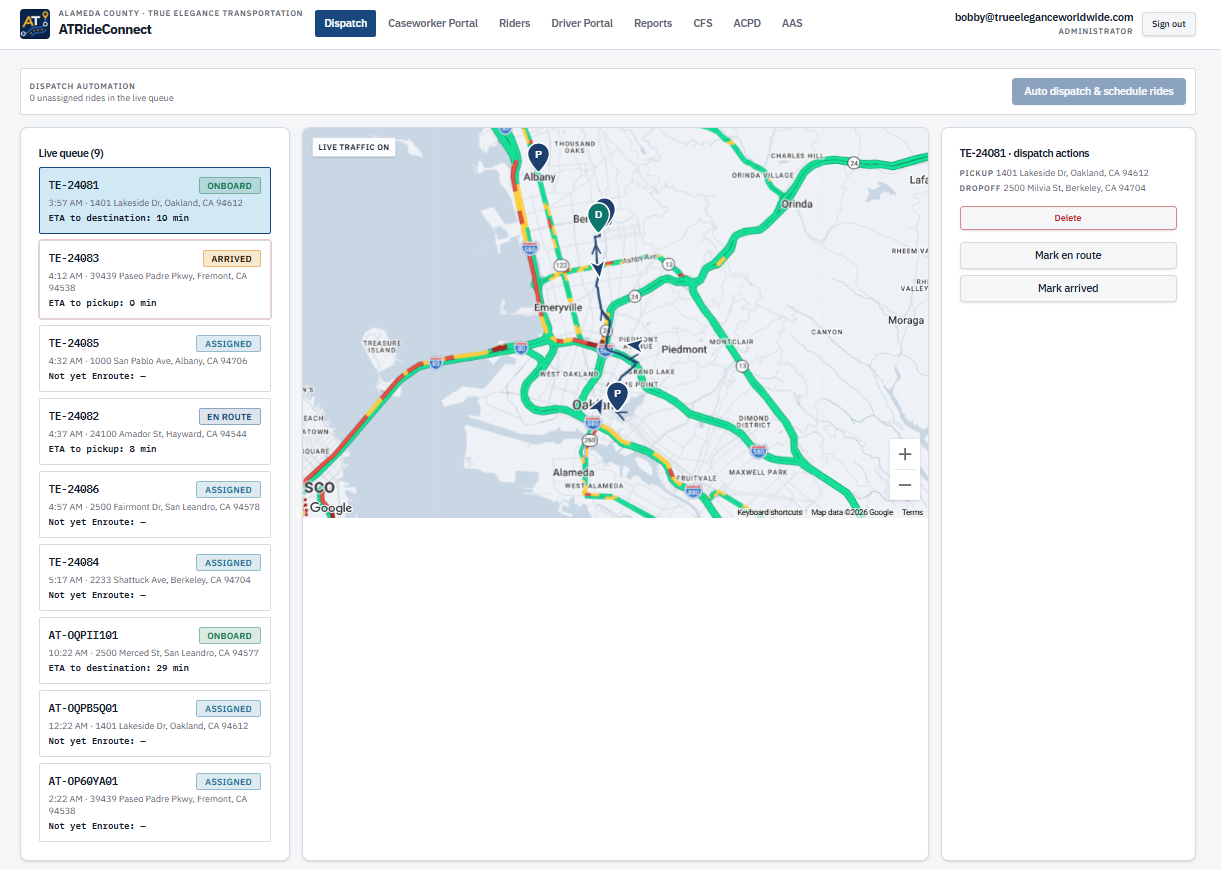
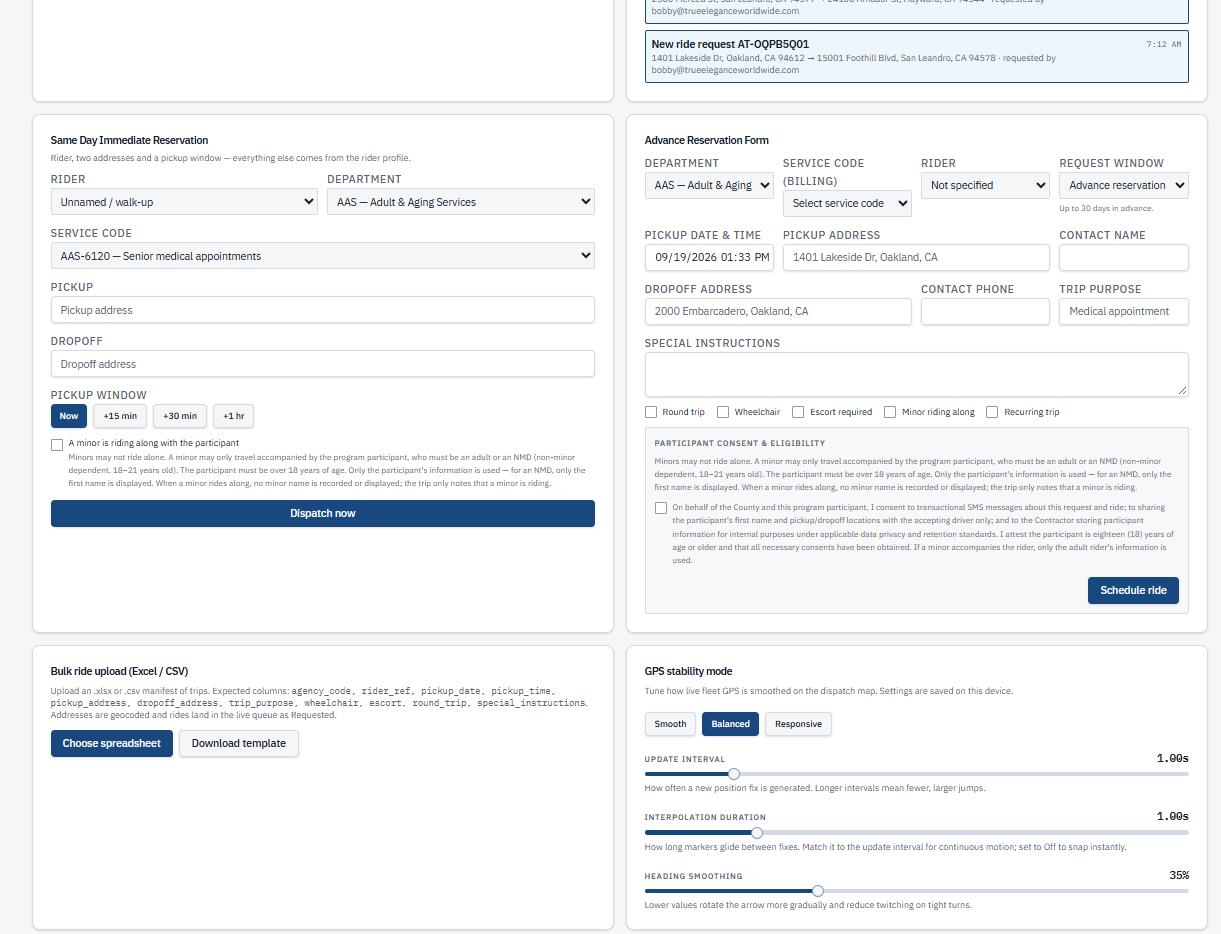
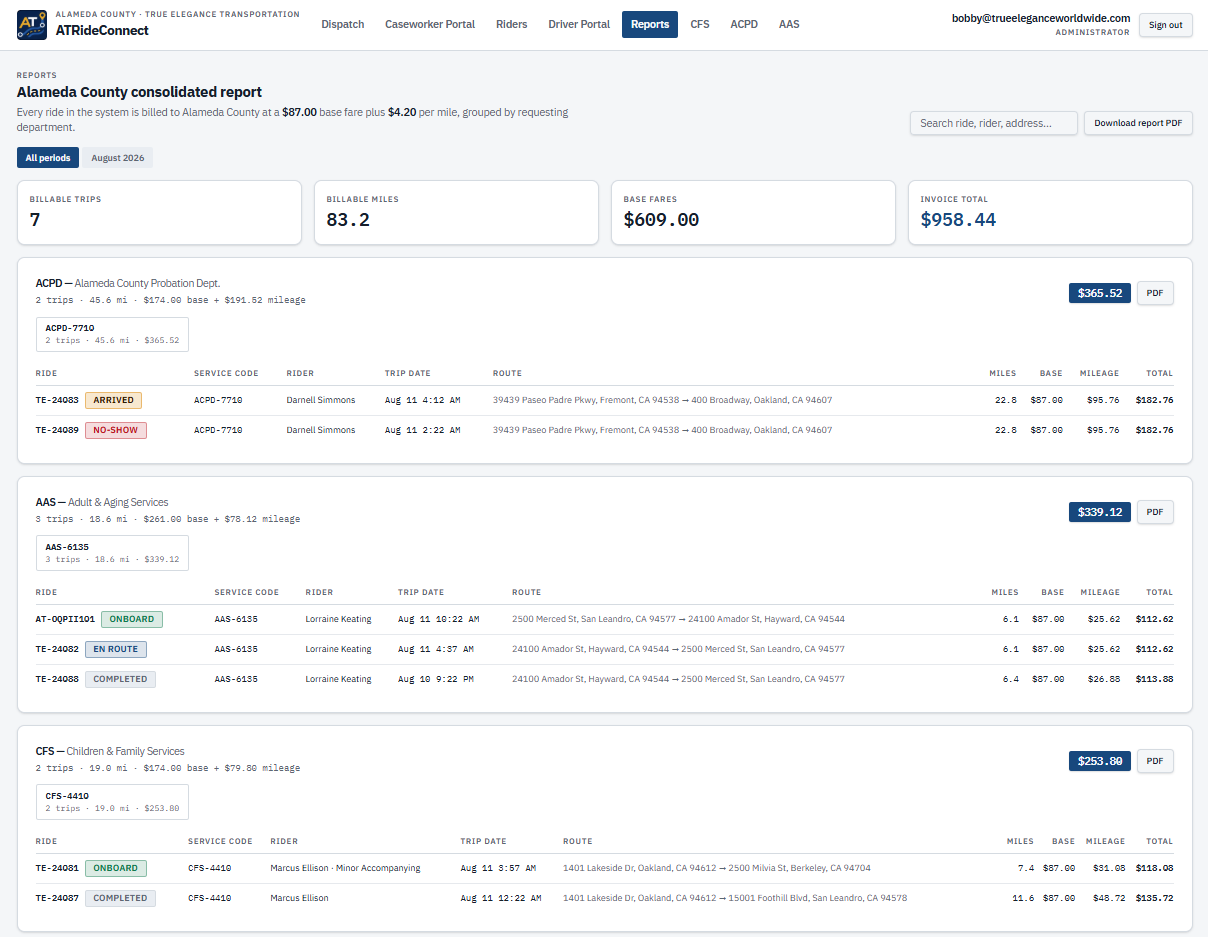
One trip. One record. One documented history.
Public transportation programs need more than vehicles and drivers. They need a system that can demonstrate what was scheduled, who performed the trip, which vehicle was used, what happened during service, whether an exception occurred, and exactly what should be billed.
When information lives in separate systems, a simple question takes hours to answer. ADA RideConnect is designed around a different model: the same trip record carries through every stage of service.
1. Reservation
An authorized coordinator submits a transportation request. Recurring transportation can be scheduled as standing service, while one-time trips are managed individually. Every reservation begins with a unique trip record.
- Rider information and program authorization
- Pickup location and destination
- Requested date and time
- Mobility requirements, wheelchair and accessibility needs
- Attendant information
- Special transportation instructions
2. Scheduling and assignment
Dispatch matches the trip with the right operational resources: driver, vehicle, route, pickup window and destination. The result is a documented assignment rather than an informal scheduling decision.
- Geographic efficiency and existing route capacity
- Vehicle capacity and accessibility requirements
- Rider compatibility and time windows
- Driver qualification
3. Pre-trip verification
Before beginning service, the driver confirms the assigned vehicle and trip. The system can capture driver and vehicle identification, pre-trip inspection completion, service start time, starting mileage, GPS location, route assignment and accessibility equipment readiness.
4. Service, verification and exceptions
During service, pickup and drop-off are verified with timestamps and GPS activity. When something changes — a late program activity, a cancellation, a no-show, a vehicle substitution — the change is recorded as part of the trip history instead of a separate message thread.
5. Billing supported by the service record
Completed trips are reviewed and approved, then billed from the same record. Instead of asking “where did this invoice number come from?”, staff can open the service history supporting the charge.
Representative rider scenario
A participant is authorized for transportation Monday through Friday between their residence and a community-based day program.
Morning service: pickup scheduled 7:20 AM, vehicle arrives 7:18 AM, passenger boards 7:23 AM, destination arrival 7:52 AM, trip completed. The record contains driver, vehicle, timestamps, GPS activity and mileage.
Afternoon exception: the return was scheduled for 3:15 PM. The day program reports the participant will remain late for an approved activity, and dispatch updates the trip to 4:00 PM. Vehicle arrives 3:57 PM, passenger boards 4:04 PM, residence arrival 4:36 PM — completed, with the schedule modification documented.
The complete transportation record
Instead of reconstructing what occurred weeks later, the service history already exists as one connected chain:
- Reservation → program authorization → route assignment
- Driver assignment → vehicle assignment → live GPS activity
- Pickup verification → drop-off verification → exception record
- Trip completion → billing record → program reporting
Program visibility
Programs can track operational measures across four areas. These are categories that can be measured from the trip record, not claims of past performance.
- Service delivery: completed, cancelled, no-show and missed trips, on-time pickups and arrivals
- Fleet operations: vehicle utilization, mileage, accessible vehicle use, substitutions, service interruptions
- Driver operations: trips performed, utilization, schedule adherence, exceptions, documentation compliance
- Financial oversight: trips awaiting review, approved billable trips, mileage billed, cost by route, rider and program, invoice reconciliation
What changes
Traditional transportation management spreads a single trip across a reservation spreadsheet, a dispatch board, driver paperwork, text messages, a GPS portal, incident records, a billing spreadsheet and an invoice.
ADA RideConnect runs reservation → dispatch → service → verification → exception → billing → reporting as one connected transportation history, so a public program can answer what was scheduled, what was delivered, what changed and what should be paid.
Process outcomes
- A single connected history from reservation through program reporting
- Exceptions and schedule modifications documented as part of the trip, not after the fact
- Invoice lines traceable to the actual service record behind each charge
- Program visibility across service delivery, fleet, driver operations and financial oversight
Build a transportation plan around your riders
Tell us what repeats, what changes and what your organization must document. We will help define the right service model.